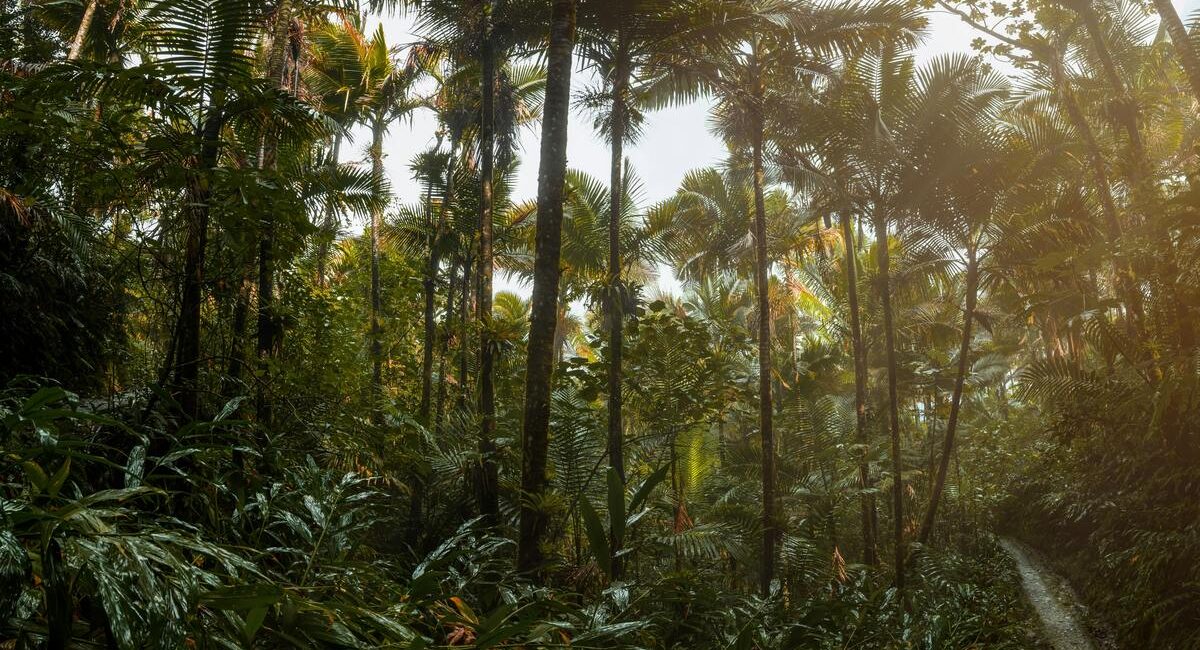
El Yunque National Forest is the only tropical rainforest in the United States National Forest System. Located in the mountains of northeastern Puerto Rico, just 45 minutes from San Juan and under 10 minutes from Coco Beach in Rio Grande, it draws more than one million visitors every year. If you are staying near Rio Grande, El Yunque is not a long drive across the island — it is your backyard.
The forest covers over 28,000 acres, receives up to 200 inches of rain annually, and shelters more than 240 tree species, 50 bird species, and 13 species of coqui frog found nowhere else on Earth. Getting the most out of a day trip requires knowing the current access rules, which trails are open, what to bring, and when to arrive. This guide gives you all of that, with specific logistics for visitors based in Coco Beach and Rio Grande.
Key Takeaways
- El Yunque National Forest is free to enter on the PR-191 corridor. No reservations required as of 2026 for general visitors.
- El Portal Visitor Center charges $8 per person (ages 16 and up); children 15 and under are free.
- Operating hours are 8:00 a.m. to 5:00 p.m. daily. All visitors must leave by 5:00 p.m. The forest is closed on December 25.
- From Coco Beach (Rio Grande), the forest entrance is approximately 10 minutes by car via PR-191 — the closest major accommodation base to the park.
- Rideshare apps (Uber, Lyft) do not operate inside the forest past El Portal. A rental car or permitted tour is the only reliable way to get around.
- La Mina Falls trail is currently closed for repairs. Juan Diego Falls and La Coca Falls are the primary waterfall destinations in 2026.
- Arrive before 9:00 a.m. on weekends. Parking fills to capacity and access is paused until spots open.
- The Puerto Rican parrot — one of the world’s rarest birds, with approximately 500 individuals remaining in the wild — can be spotted in El Yunque’s upper elevations.
What Makes El Yunque Truly Unique
El Yunque is the only tropical rainforest managed by the United States Forest Service. Every other national forest in the country exists in a temperate climate. El Yunque is different by every ecological measure: year-round tropical temperatures between 70 and 80 degrees Fahrenheit, annual rainfall measured in feet rather than inches, and a biodiversity density that rivals much larger forests in Central and South America.
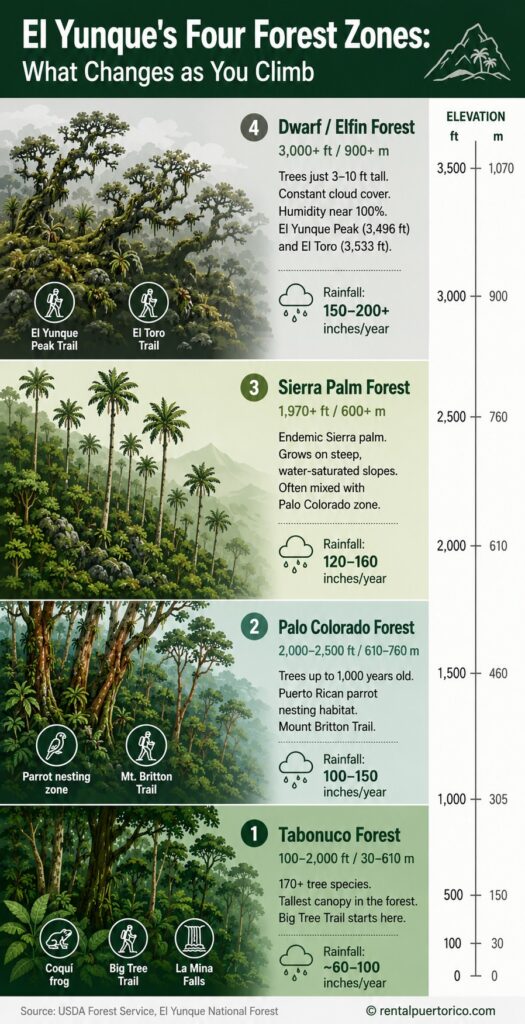
The forest contains four distinct vegetation zones. The Tabonuco forest dominates the lower elevations and is home to the large Tabonuco tree, which can live for centuries. The Palo Colorado forest occupies mid-elevations, where tree roots spread across mossy ground and cloud cover begins to thicken. The Sierra Palm forest grows at higher elevations alongside streams and waterfalls. At the summit, the Dwarf Forest — also called Elfin Forest — consists of stunted, gnarled trees shaped by constant wind and moisture.
Pre-Columbian Taino people considered the mountain sacred. The name El Yunque is derived from the Taino word ‘yuké,’ meaning white lands, a reference to the clouds that permanently cap the upper peaks. The forest remains a cultural landmark for Puerto Rico alongside its designation as a federal natural resource.
Twenty percent of Puerto Rico’s fresh water originates in El Yunque. The forest’s elevation and density intercept rainfall and feed the rivers that supply the island’s northeastern municipalities.
Getting There from Coco Beach and Rio Grande
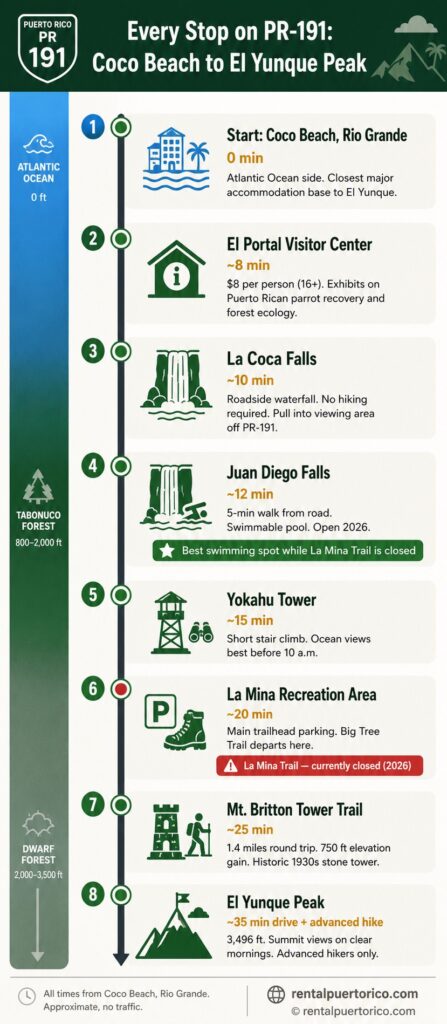
Guests staying at the Grand Hyatt Reserve area in Coco Beach have the most direct access to El Yunque of any major accommodation base in Puerto Rico. The distance from Coco Beach to the El Portal Visitor Center at the PR-191 park entrance is approximately 3.5 miles, a drive of under 10 minutes without traffic. This is a significant advantage over visitors coming from San Juan, who face a 45-minute highway drive.
The route from Coco Beach is straightforward. Take PR-968 or local roads north to PR-3, then turn south onto PR-191 (also called Forest Highway 191). PR-191 runs directly from Rio Grande’s town center up into the forest, past El Portal Visitor Center and La Coca Falls, continuing up to La Mina Recreation Area and beyond.
Visitors from San Juan arrive via PR-26 east, merging onto PR-66 (a toll road), then PR-3 south toward Rio Grande. The PR-191 exit into the forest sits in a residential neighborhood and is easy to miss without GPS. Set your destination to ‘El Portal Visitor Center, El Yunque’ before departure.
Rideshare services including Uber are not permitted to drop off or pick up passengers past El Portal Visitor Center. The forest service explicitly advises against relying on these apps because they do not register valid pickup points inside the park, which has left visitors stranded. Visitors arriving without a rental car must book with a tour operator holding a permit to operate in El Yunque, or arrange a licensed taxi.
Travel time to El Yunque by departure point
| Departure Point | Approximate Drive Time | Main Route |
| Coco Beach / Rio Grande | Under 10 minutes | PR-3 south to PR-191 |
| Luquillo | 20 minutes | PR-3 west to PR-191 |
| San Juan (Old San Juan) | 45-55 minutes | PR-26 east, PR-66 east, PR-3, PR-191 |
| Fajardo | 25-30 minutes | PR-3 west to PR-191 |
| Ponce (south coast) | 90 minutes | PR-52 north to PR-3 east to PR-191 |
Best Hiking Trails for Every Level
El Yunque maintains 12 official trails covering a range of distances and elevation gains. The majority of popular trails depart from the PR-191 corridor and are accessible from the parking areas near El Portal Visitor Center and the La Mina Recreation Area. Difficulty ratings below reflect both trail length and terrain conditions, which include tree roots, slick rock surfaces, and steep stone staircases.
Beginner Trails
Big Tree Trail is the most accessible hike in El Yunque for first-time visitors and families. The trail runs 1.2 miles round trip through the Tabonuco forest zone, passing large canopy trees and ending at La Mina Falls — though the final approach to the falls is currently closed pending 2026 repairs. The elevation gain is minimal and the path is well-maintained. Expect this hike to take 45 minutes to one hour round trip at a relaxed pace.
Juan Diego Creek Trail requires virtually no hiking. Juan Diego Falls is a 5-minute walk from the PR-191 roadside. The pool at the base of the falls is shallow enough for comfortable swimming and is particularly suitable for children. Lower Juan Diego Falls is accessible with no significant scrambling. Upper Juan Diego Falls requires a short but steep and muddy climb above the lower pool — rewarding, with far fewer visitors than any other waterfall in the park.
Moderate Trails
La Mina Trail runs 1.4 miles round trip through the Tabonuco forest and follows the La Mina River upstream to La Mina Falls, a 35-foot waterfall cascading into a swimmable pool. The trail is rated moderate because the return hike is an uphill climb on steps that can challenge visitors not accustomed to sustained inclines. As of early 2026, La Mina Trail remains closed for infrastructure repairs. Check the official US Forest Service conditions page at fs.usda.gov/elyunque before your visit, as the reopening is anticipated during 2026.
Mount Britton Tower Trail begins from the Palo Colorado picnic area and climbs 0.7 miles to the Mount Britton observation tower, a historic stone structure built in the 1930s. The elevation gain is approximately 750 feet. On clear mornings, the tower offers unobstructed views over the forest canopy to the Atlantic coast. The trail ascends through stone staircases and can be slippery after rain.
Advanced Trails
El Yunque Peak Trail is a 5.4-mile round trip hike to the summit at 3,496 feet. The trail gains approximately 2,000 feet in elevation and requires 5 to 7 hours round trip. Summit views on clear mornings extend to San Juan to the northwest and the Caribbean coast to the south. This trail is suited to experienced hikers in good physical condition.
El Toro Trail accesses El Toro Peak at 3,533 feet, the highest point in the Caribbean National Forest, via Road 186 on the forest’s western side. The trail runs 2.3 miles one way and passes through remote cloud forest terrain. El Toro Trail is in a separate section of the park and is significantly less visited than PR-191 trails. Road 186 has poor road conditions; use a vehicle with reasonable clearance.
El Yunque trail comparison
| Trail | Round Trip | Difficulty | Highlight | 2026 Status |
| Big Tree Trail | 1.2 miles | Easy | Tabonuco forest, approach to falls | Open |
| Juan Diego Falls | 0.3 miles | Easy | Swimmable pool, low crowds | Open |
| La Mina Trail | 1.4 miles | Moderate | 35-ft waterfall, swimming pool | Closed (2026) |
| Mt. Britton Tower | 1.4 miles | Moderate | Historic tower, canopy views | Open |
| El Yunque Peak | 5.4 miles | Advanced | Summit at 3,496 ft, panoramic views | Check conditions |
| El Toro Trail | 4.6 miles | Advanced | Highest point in forest, 3,533 ft | Via Road 186 |
Waterfalls You Cannot Miss: La Mina, Juan Diego, and La Coca
El Yunque has three accessible waterfalls along the PR-191 corridor, each requiring different levels of effort and offering a different experience.
La Coca Falls stands immediately beside PR-191, approximately 1 mile from the El Portal entrance. There is no hike — visitors pull into the roadside viewing area and stand within 30 feet of a wide cascade falling from a basalt cliff face. La Coca Falls is the easiest waterfall stop in the park and produces excellent photographs. The water volume varies significantly after rain; visiting within 24 hours of a heavy rainfall produces a dramatically larger cascade.
Juan Diego Falls sits just off PR-191 and requires a 5-minute walk to the lower falls. The pool is shallow, clear, and surrounded by forest cover, making it the best swimming spot currently accessible in El Yunque while La Mina Trail remains closed. Upper Juan Diego Falls requires an additional 10-minute steep, muddy scramble from the lower pool but receives far fewer visitors. Those willing to make the climb find a larger waterfall and near-total solitude even on busy weekends.
La Mina Falls, the most photographed waterfall in El Yunque, cascades 35 feet into a deep green pool. The 1.4-mile La Mina Trail that leads there has been closed for infrastructure repairs since Hurricane Maria damage recovery and as of early 2026 remains closed. The reopening is anticipated during 2026. Check fs.usda.gov/elyunque for current trail status before planning a visit specifically for this waterfall.
Yokahu Observation Tower is not a waterfall but deserves mention as a key stop between waterfall visits. The tower stands at mid-elevation on PR-191 and requires only a short walk and a staircase climb. On clear mornings — typically before 10:00 a.m. — the tower offers views over the forest canopy toward the Atlantic Ocean. No entrance fee and no reservation required to climb Yokahu.
Wildlife: Coqui Frogs, Puerto Rican Parrots, and More
El Yunque shelters species found nowhere else on Earth. Understanding what to look and listen for before arriving significantly improves the experience.
The coqui frog is Puerto Rico’s unofficial national symbol and the most recognizable sound in El Yunque. Thirteen species of coqui are endemic to Puerto Rico, meaning they live only on the island. The call — a two-note ‘ko-kee’ that gives the frog its name — becomes audible at dusk and continues through the night. Coquis are present throughout the forest and are most easily heard in the evening, though visitors who move quietly through shaded areas during the day frequently encounter them on leaves and bark.
The Puerto Rican parrot (Amazona vittata) is one of the world’s rarest birds. The wild population declined to approximately 13 individuals in 1975 before a conservation program at El Yunque began releasing captive-bred birds into the forest. The current wild population stands at approximately 500 individuals. Sightings are rare but possible, particularly in upper-elevation areas above the Palo Colorado zone. The birds are bright green with a red forehead and a distinctive call. El Portal Visitor Center displays live exhibits featuring the parrot alongside information on the recovery program.
Additional wildlife commonly encountered in El Yunque includes the Puerto Rican lizard cuckoo, Puerto Rican tody (a small green-and-red bird endemic to the island), various species of hawk, and the small Indian mongoose — an introduced species that feeds on eggs and small reptiles. Mongooses are frequently seen crossing forest trails and should not be fed or approached. Multiple species of Puerto Rican tree lizard (anole) are visible on rocks and tree trunks throughout the park.
Marine mammals occasionally visible from the coastal areas near Rio Grande include sea turtles in nearby Espiritu Santo River and bay areas. El Yunque itself is an inland mountain forest, but its proximity to the coast means that a day combining a forest morning with an afternoon at Luquillo Beach — 20 minutes north on PR-3 — is entirely practical and common.
Practical Information: Entrance, Hours, Fees, and What to Bring
Entrance and Fees
Entry to El Yunque National Forest on the PR-191 corridor is free. No reservation is required for general forest access as of 2026. Visitor capacity is managed by the Puerto Rico Police through parking limitations rather than timed-entry reservations. When parking reaches capacity, entry pauses until spaces open.
El Portal Visitor Center charges $8.00 per person for visitors aged 16 and older. Children 15 and under enter free. Holders of National Parks Annual Passes, Senior Passes, Military Passes, and Access Passes receive a 50 percent discount, paying $4.00. El Portal’s exhibits include an interactive display on forest ecology, a film about El Yunque, and interpretive materials on the Puerto Rican parrot recovery program.
Hours
The La Mina Recreation Area on PR-191 is open from 8:00 a.m. to 5:00 p.m. daily. All visitors must leave the recreation area, including trails and parking areas, by 5:00 p.m. Violations are subject to fines. The forest is closed on December 25. Closures also occur during extreme weather events or when ongoing construction work presents safety concerns.
El Portal Visitor Center maintains separate hours: open daily except Thanksgiving, Christmas Day, New Year’s Day, and Three Kings Day (January 6). Operating hours are 8:00 a.m. to 4:00 p.m.
Transportation Note
Rideshare apps including Uber and Lyft are not authorized drop-off or pick-up points at La Coca Gate or El Portal. The US Forest Service explicitly warns that visitors relying on these services have been left waiting for hours because the apps do not register valid pickup coordinates inside the park. A rental car is the most reliable means of transportation. Guests at Coco Beach hotels and rental condos can reach the forest entrance in under 10 minutes without using a highway.
What to Bring
- Waterproof hiking shoes with ankle support — trail surfaces are wet, rooted, and rocky. Sandals and flip-flops are not appropriate for any trail in El Yunque.
- Swimsuit and quick-dry towel — Juan Diego Falls and, when reopened, La Mina Falls provide swimmable pools.
- Water: minimum 2 liters per person for a half-day visit. There are no food vendors inside the forest.
- Insect repellent — mosquitoes are present and active throughout the forest, particularly in lower elevation areas near standing water.
- Rain jacket or poncho — El Yunque receives rain year-round and afternoon downpours are common regardless of morning weather.
- Offline maps: cell service is unreliable inside the forest. Download the AllTrails map for El Yunque or the official forest map from fs.usda.gov/elyunque before departure.
- Cash: there are no ATMs inside El Yunque. El Portal entrance fee can be paid by card, but nearby food vendors and parking may require cash.
- Trash: there are no trash cans inside the park. Pack out everything you bring in.
Best Time of Day to Visit
Arriving between 7:00 a.m. and 9:00 a.m. is the single most effective strategy for a successful El Yunque day trip. Early arrival provides the three most important advantages: parking availability, clear visibility from observation towers before cloud cover thickens, and lower trail temperatures before midday humidity peaks.
Afternoon thunderstorms are common across all seasons in El Yunque. The forest receives precipitation year-round as a structural feature of its ecosystem, not as a seasonal anomaly. Visitors who arrive early complete the main trails and waterfall stops before weather deteriorates, typically by 1:00 p.m. to 2:00 p.m. Visitors arriving after noon frequently encounter reduced visibility at towers and heavier rain on trails.
Weekends from July through August represent the highest-traffic period. El Portal parking fills to capacity by 10:00 a.m. on peak weekends. Arriving at 7:30 a.m. on a weekend provides reliable access to parking. Arriving at 10:00 a.m. or later on a summer weekend creates a genuine risk of being turned away at the gate until spaces open.
December through March is the dry season by Puerto Rico standards, though El Yunque receives rain even in its driest months. This period sees lower peak temperatures on the upper trails, which makes it preferable for the El Yunque Peak and El Toro advanced hikes. September through November is hurricane season; El Yunque may close on short notice during tropical weather events.
El Yunque seasonal visitor overview
| Season | Months | Conditions | Crowd Level |
| Dry season | December – March | Lower temperatures, less rain | Moderate |
| Spring transition | April – May | Warming, increased rainfall | Low to moderate |
| Peak season | June – August | Hot, frequent afternoon rain, lush canopy | High. Arrive before 9 a.m. |
| Hurricane season | September – November | Heaviest rainfall, closure risk | Low |
Suggested One-Day Itinerary from Coco Beach
The following itinerary is designed for visitors based at Coco Beach or Rio Grande. The short drive to the forest entrance makes an early start practical without requiring predawn departure.
7:30 a.m. — Depart Coco Beach. Drive south on local roads to PR-3, then south on PR-191. Park at El Portal or continue up PR-191 to the La Mina Recreation Area parking lot. On weekdays, parking is rarely an issue at this hour.
7:45 a.m. — La Coca Falls. This stop is immediately off PR-191 and requires no hiking. Photograph the falls with morning light before other visitors arrive. Five to ten minutes is sufficient.
8:00 a.m. — Juan Diego Falls. A 5-minute walk from the PR-191 roadside. Swim in the lower pool. Experienced hikers with time can continue 10 minutes to Upper Juan Diego Falls. Allow 45 minutes to 90 minutes for this stop.
9:30 a.m. — Yokahu Observation Tower. Drive or walk up PR-191 to the tower. Climb the interior staircase for views over the forest canopy. Morning cloud cover is typically thinnest before 10:00 a.m. Allow 20 to 30 minutes.
10:00 a.m. — Mount Britton Tower Trail. This 1.4-mile round trip hike with 750 feet of elevation gain through the Palo Colorado forest ends at a 1930s stone observation tower. Carry water and expect the stone steps to be slick if it rained overnight. Allow 90 minutes to 2 hours.
12:00 p.m. — Return to your vehicle and drive back down PR-191 toward PR-3. Stop at Luquillo Beach (20 minutes north) for lunch at the Kioskos de Luquillo — beachfront food stalls serving Puerto Rican fried snacks, fresh seafood, and coconut drinks.
2:00 p.m. — Optional: continue to El Portal Visitor Center if not visited in the morning. The $8 entrance fee covers exhibits on Puerto Rican parrot conservation, forest ecology, and Taino history. Allow 45 minutes.
By 3:00 p.m. — Return to Coco Beach. Drive is under 10 minutes. The full day in the forest, including driving, hiking, and swimming, fits comfortably before the park’s 5:00 p.m. closure without rushing.
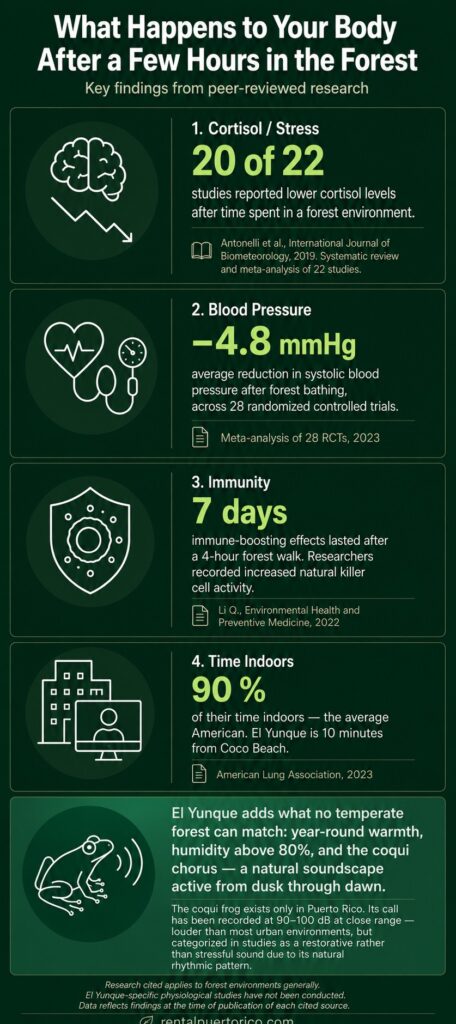
Research cited applies to forest environments generally. El Yunque-specific physiological studies have not been conducted.
After the Hike: Recover at Your Oceanfront Condo
El Yunque is a physically active destination. A morning of hiking, waterfall swimming, and tower climbing leaves most visitors ready for rest by early afternoon. The Coco Beach condo at Grand Hyatt Reserve sits less than 10 minutes from the forest entrance, which makes the recovery portion of the day unusually easy.
Step onto the balcony from the condo’s upper floor and look southwest toward the mountains. On clear afternoons, the ridge of El Yunque’s upper slopes is visible from Coco Beach — the same canopy you walked through in the morning is the silhouette on the horizon. The full circle of the El Yunque day trip closes right there, without any additional driving.
The condo’s dual balconies face both the Atlantic Ocean and the interior island landscape. Guests recovering from a forest morning can sit on the ocean-facing balcony and hear the Atlantic, then switch to the inland-facing balcony and see El Yunque’s peaks. This is not a view available from San Juan hotels — it requires being based in Rio Grande.
Guests who prefer a different kind of morning activity have the Grand Reserve Golf Club immediately adjacent to the property — an 18-hole championship course designed by PGA professional Tom Kite, with views of the Atlantic and the El Yunque ridge from the back nine. A full overview of golf courses in Puerto Rico — including Grand Reserve and other top-rated courses across the island — is available in a separate guide.
Frequently Asked Questions
Do I need a reservation to visit El Yunque in 2026?
No reservation is required to enter El Yunque National Forest on the PR-191 corridor as of 2026. Entry is first come, first served. Access may pause temporarily when parking reaches capacity, particularly on summer weekends. School groups are the exception and must reserve in advance.
Is there an entrance fee for El Yunque?
Entry to the main forest on PR-191 is free. El Portal Visitor Center charges $8.00 per person for visitors 16 and older; children 15 and under are free. Holders of US National Park passes receive a 50 percent discount at El Portal.
What time does El Yunque close?
The La Mina Recreation Area is open from 8:00 a.m. to 5:00 p.m. daily. All visitors — including those on trails — must exit by 5:00 p.m. The forest is closed on December 25 and during extreme weather events.
Can I take an Uber or Lyft to El Yunque?
Rideshare services including Uber and Lyft are not authorized to drop off or pick up passengers past El Portal. The US Forest Service warns that rideshare apps do not register valid pickup points inside the forest, which has left visitors stranded for hours. A rental car or a licensed tour operator with a park permit is required for reliable transportation inside El Yunque.
Is La Mina Falls open in 2026?
La Mina Trail leading to La Mina Falls remains closed as of early 2026 for ongoing infrastructure repairs following damage from Hurricane Maria. The reopening is expected during 2026. Check the current conditions at fs.usda.gov/elyunque or at El Portal Visitor Center on arrival. Juan Diego Falls is the primary accessible swimming waterfall while La Mina Trail is closed.
How long should I plan for an El Yunque day trip?
Plan a minimum of 4 to 5 hours to see the main attractions: La Coca Falls, Juan Diego Falls, Yokahu Tower, and one hiking trail. A full day of 6 to 8 hours allows for multiple trails, swimming time at waterfalls, and a visit to El Portal Visitor Center. Guests based in Coco Beach can arrive at opening and return comfortably by early afternoon.
Can I swim in El Yunque?
Swimming is permitted at designated natural pools. Juan Diego Falls has a swimmable pool currently accessible. La Mina Falls pool will be accessible again once the trail reopens. Swimming is not permitted at La Coca Falls, which is a roadside viewing waterfall only. Never swim during or immediately after heavy rainfall due to flash flood risk in river channels.
Is El Yunque safe for children?
El Yunque is well-suited for families with children. Big Tree Trail and Juan Diego Falls are accessible for children of most ages. The Yokahu Observation Tower requires only a short walk and stair climb. Supervise children closely near waterfall pools and river edges. Wear appropriate footwear — trail surfaces are slippery throughout the forest, including near water.
What animals might I see in El Yunque?
Common wildlife encounters include coqui frogs (audible throughout the forest), various tree lizards and anoles, mongooses crossing the trails, and multiple endemic bird species including the Puerto Rican tody and lizard cuckoo. The Puerto Rican parrot is present in the forest but sightings are rare, occurring most often in upper-elevation areas. Snakes are extremely rare in El Yunque and no venomous species are present on the island.
What is the best time of year to visit El Yunque?
December through March is the dry season and offers the most predictable weather for hiking, with lower temperatures at upper elevations. July and August are the busiest months due to US school vacations. September through November is hurricane season, which brings the heaviest rainfall and a risk of closures. El Yunque is open year-round and each season produces a different and equally valid forest experience.
How far is El Yunque from Coco Beach?
El Yunque’s El Portal entrance on PR-191 is approximately 3.5 miles from the Coco Beach area of Rio Grande — a drive of under 10 minutes in normal traffic. This makes Coco Beach the closest major accommodation base to El Yunque, significantly closer than San Juan hotels which face a 45-minute drive.
Stay 10 minutes from El Yunque with Atlantic Ocean views. Book your beachfront vacation rental in Puerto Rico at Grand Hyatt Reserve, Coco Beach, Rio Grande — the closest major accommodation base to El Yunque National Forest.